Home Services Marketing » News » Google Researchers Explore a New LLM-Based Approach
AI & Search News
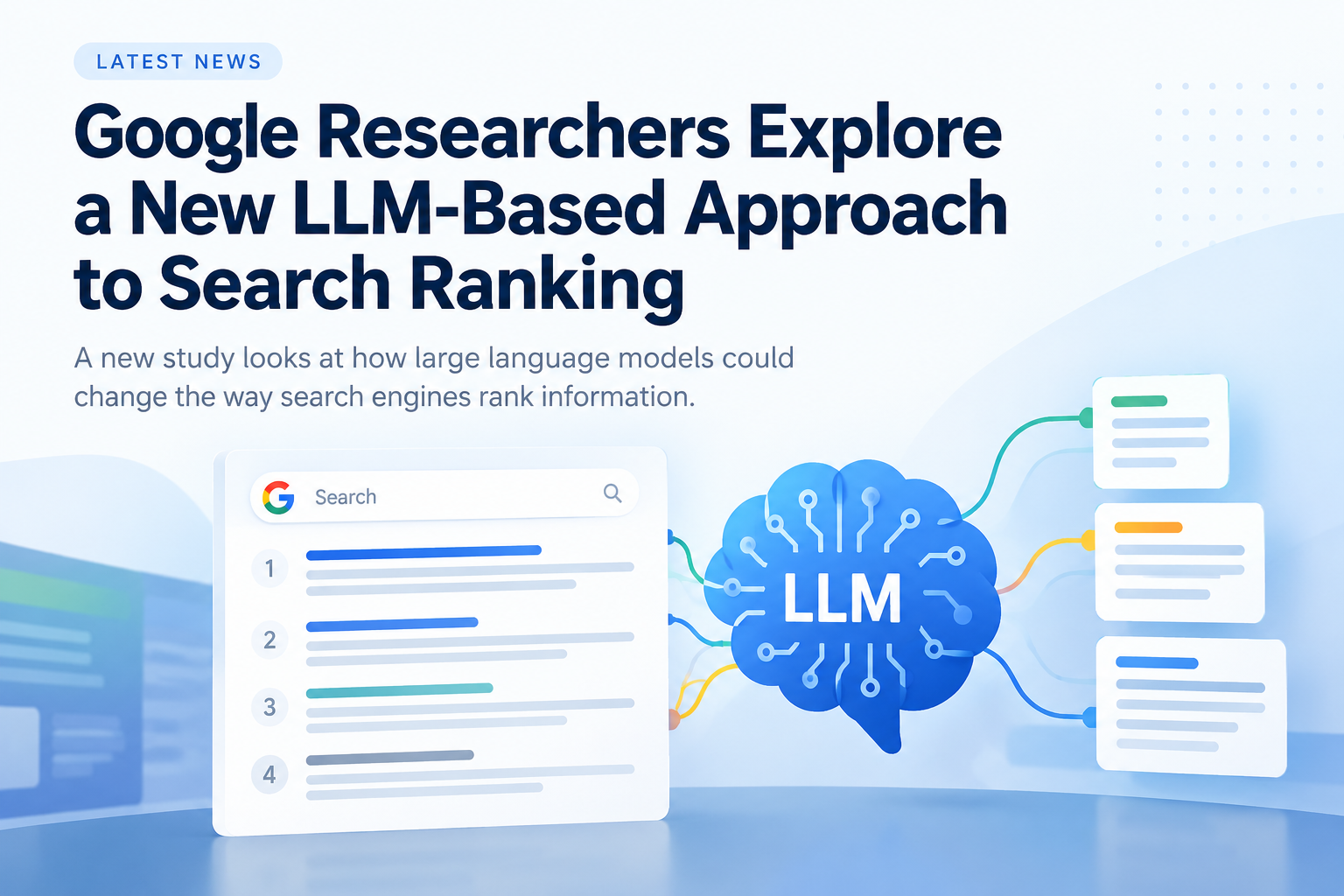
Google Researchers Explore a New LLM-Based Approach to Search Ranking
Industry
Search & AI
Focus
AI-Powered Search & Ranking
Published
September 19, 2026
AI & Search Technology Updates
How LLMs Could Change the Future of Search Ranking
Google researchers and academic collaborators have published new research exploring whether large language models (LLMs) could change how search engines rank documents.
The paper, “Autoregressive Ranking: Bridging the Gap Between Dual and Cross Encoders,” introduces a method called Autoregressive Ranking (ARR), which uses an LLM-based approach to rank search results rather than relying solely on the traditional multi-stage retrieval architecture.
The researchers also propose SToICaL, a training method designed to make the model more aware of document relevance and ranking order. Their experiments on WordNet and ESCI shopping-search datasets found that the approach improved several ranking metrics and was able to better suppress irrelevant document results.
The research also presents a theoretical argument that autoregressive ranking can represent rankings without the same embedding-dimension limitations associated with dual encoders.
However, the findings are still research-stage results, rather than evidence that Google has replaced its production search-ranking systems with LLMs. The experiments were conducted on specific research datasets, so their implications for real-world search remain to be established.
What Home Services Marketing Experts Say
Why This Matters
For SEO and AI search professionals, this research is worth watching. While it does not indicate that Google is replacing its current ranking systems with LLMs, it highlights a direction search technology could take. As AI becomes more deeply integrated into search, businesses may need to think beyond traditional rankings and focus on creating content that is relevant, useful, clearly structured, and easy for increasingly sophisticated retrieval and ranking systems to understand.

Chan K
Home Services Marketing
Maximize Growth. Dominate Your Market. Delivering Impact Worldwide
Ready to consult with our marketing expert?
Solutions
Industries
About Us
Helping Home Services Companies Stand Out in Local Market, Attract High Quality Leads, and Drive Real Business Growth.
Have Any Questions? support@homeservices.marketing